Showing posts with label Natural Disasters. Show all posts

Wednesday, August 17, 2016

How Tsunamis Work

Here is a TED Ed video about how tsunamis work. Watch the video and do the tasks below.

For full screen view click here.


Worksheet
Here is a worksheet based on a TED Ed video about how tsunamis work. There is a vocabulary matching exercise and two listening comprehension exercises (gap-fill and True/False). B/W copy and Answer Key provided.


To download the worksheet click here.

Friday, May 1, 2015

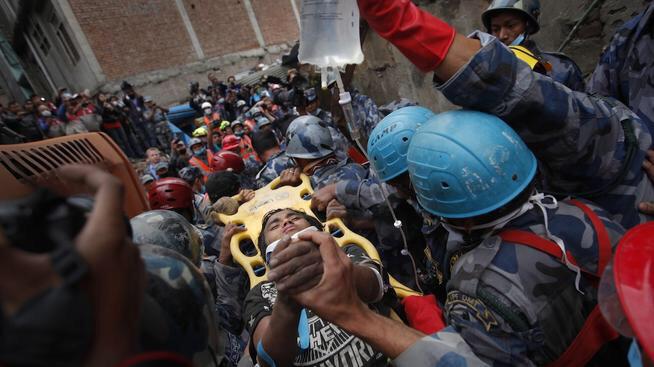
Nepal: Miracle rescues of teenager and baby bring joy amid earthquake tragedy (video)

Before watching the video, read the comprehension questions and study the words in the vocabulary section below.


Comprehension Questions

  1. Where was the teenager found?
  2. How long had he been trapped in the ruins?
  3. How many hours after the earthquake was the baby found?
  4. What alerted the rescue teams to search for him?
  5. How many people have been affected by the earthquake?
  6. What dangers are the earthquake victims facing now?

Vocabulary 

  • Rubble are broken pieces of stone, brick, etc., from walls or buildings that have fallen. e.g. Rescue workers managed to pull two injured people out of the rubble.
  • When you assess something, you make a judgment about it. e.g. After the hurricane, officials assessed  the town's need for aid.
  • When you alert someone, you give them important information about a possible problem, danger, etc., you warn them. e.g. Several neighbors alerted  the authorities/police when they noticed strangers acting suspiciously.
  • A rural area is an area in the countryside. e.g. She lives in a rural  area.
  • When you scramble for something, you try very hard to get it before someone else does. e.g. Both players scrambled  for the ball.


https://pbs.twimg.com/media/CD1EwfhWoAA4PRh.jpg:large 

Monday, September 29, 2014

Japan: 30 hikers feared dead on erupting volcano Mount Ontake

At least 30 people are believed to have died near the peak of a volcano in central Japan that erupted without warning on Saturday, trapping scores of amateur climbers and covering a wide area with thick ash. (The Guardian , Sunday 28 September)


Source: euronews

Study the vocabulary below and then watch the video.


Vocabulary
  • The peak of a mountain is the top of a mountain. e.g. snow-covered peaks
  • When a volcano erupts, it explodes inside and flames, rocks, and lava come out of the top. e.g. The volcano erupted with tremendous force.
  • authorities [plural] : people who have power to make people obey rules and laws. e.g. Local authorities are investigating the accident.
  • If you are stranded somewhere, you are left in a place without a way of leaving it. e.g. Hundreds of passengers were left stranded at the airport.
  • If you fling something, you throw it in a sudden and forceful way. (fling-flung-flung) e.g. They flung their hats into the air.
  • When you take shelter somewhere, you go to a place in which you are protected from bad weather or danger. e.g. They took shelter in a cave during the storm.
  • If you resume an activity, or if it resumes, it begins again or continues after stopping e.g. After the rain stopped, the teams resumed play.

Now watch the video again and try the following quiz.

Transcript 
At least 30 hikers are feared dead in Japan after being found at a lifeless state near the peak of a volcano that erupted a day earlier.
Japanese authorities never confirm death until after a medical examination.
Others were injured or are missing. 
This amateur video was taken inside a mountain hut as people took shelter from volcanic ash and rocks.
Hundreds of people including children were stranded on Mount Ontake, some 200 kilometres west of Tokyo, after it suddenly erupted on Saturday.
Smoke and ash was flung hundreds of metres into the sky, and several kilometres down the slope of the volcano.
More than 500 emergency staff including the military resumed their work on Sunday morning, helping stranded victims and looking for those still missing.
“The volcanic rocks fell like hailstones,” he says. “We couldn’t breathe so we covered our mouths with towels. We couldn’t open our eyes either.”
At one stage on Saturday some 250 hikers were stranded on the mountain but most managed to make it down by nightfall.
More than 30 people spent the night in mountain huts, most of whom came down on Sunday morning.
Volcanoes erupt periodically in Japan but until this weekend no one had died for more than twenty years.

In Pictures

http://www.theguardian.com/world/gallery/2014/sep/27/escape-from-mount-ontake-in-pictures?index=15

Escape from Mount Ontake (The Guardian)  
 

Tuesday, May 20, 2014

Bosnia and Serbia floods (video listening)

Residents face destroyed homes in Serbia's waterlogged Obrenovac

May 19 - Residents in Obrenovac, Serbia, examine the damage to their homes after devastating floods in the Balkans leave tens of thousands displaced and brace for more floodwaters. Mana Rabiee reports.


Vocabulary


  • If an area is waterlogged, it is filled or soaked with water. e.g. They couldn't play because the pitch was waterlogged.
  • If you are bracing for something, you are getting ready for something difficult or unpleasant. e.g. The town is bracing for a busy tourist season.
  • When people are evacuated, they are moved from a place of danger to a safer place. e.g. During World War II, children were evacuated from London to the country.
  • Displacement is the act of forcing people or animals to leave the area where they live. e.g. The war has caused the displacement of thousands of people.
  • A swollen river contains more water than normal as a result of heavy rain. 


Now you can try the following quiz:

Tuesday, May 6, 2014

Natural Disasters (Quizlet / Word Dynamo / Worksheet)

Fun games and activities to study or revise Natural Disasters vocabulary

Click View this study set if you prefer to do the activities on Quizlet


Alternatively, you can try the activities below.


http://dynamo.dictionary.com/495174/natural-disasters

Natural Disasters | Word Dynamo


Natural Disasters Crossword Puzzle Worksheet 


To download the Natural Disasters worksheet click here .
http://www.scribd.com/doc/222337508/Natural-Disasters


Photos of Natural Disasters 

National Disasters and Weather - National Geographic
Natural Disasters Pictures - Discovery Channel
20 Amazing Photos of Natural Disasters - ODDEE

Natural Disasters (crossword puzzle)

Look at these photos of natural disasters and solve the crossword puzzle.


If the crossword doesn't appear, you should configure Java to allow this application from http://icrossword.com

Monday, May 5, 2014

Natural Disasters: Afghan Landslide (video listening)

Afghan Landslide Site Declared Mass Grave By Authorities 

May 3 - Afghan officials have declared the site where landslides buried thousands of people a mass grave, saying it's impossible to recover those trapped.


Watch the video and answer the following questions. 

  1. When did the tragic disaster occur?
  2. What caused the landslide?
  3. What happened to the villagers who rushed to the scene to help?
  4. Why have rescuers given up hope of finding any more survivors?
  5. How many people have been displaced by the disaster?

Vocabulary

  • to pummel (v): to cause a lot of damage to a place e.g. Hurricane Mitch is pummeling the Atlantic coast. 
  • debris (n): the pieces that are left after something has been destroyed e.g. After the earthquake, rescuers began digging through the debris in search of survivors.
  • wreckage (n):  the broken parts of a vehicle, building, etc., that has been badly damaged or destroyed e.g. The pilot was trapped in the wreckage for almost seven hours. 
  • death toll (n): the number of people who die in an accident, disaster, war, etc. e.g. The death toll has now risen to 200.
  • to wreak havoc means to cause great damage e.g. The virus wreaked havoc on my computer. 
  • rubble (n): broken pieces of stone, brick, etc., from walls or buildings that have fallen e.g.
    Rescue workers managed to pull two injured people out of the rubble.


 SOURCE: http://www.boston.com/bigpicture/2014/05/afghanistan_landslide_rescuers_give_up_hope_o.html

Afghan Landslide (Vocabulary) crossword

Solve the crossword using key words from the video.


Related articles

Sunday, March 10, 2013

Japan Earthquake, 2 Years Later

SOURCE: The Atlantic - In Focus

Tomorrow, March 11th, Japan marks the 2nd anniversary of the devastating Tohoku earthquake and resulting tsunami. The disaster killed nearly 19,000 across Japan, leveling entire coastal villages. Now, nearly all the rubble has been removed, or stacked neatly, but reconstruction on higher ground is lagging, as government red tape has slowed recovery efforts. Locals living in temporary housing are frustrated, and still haunted by the horrific event, some displaying signs of post-traumatic stress disorder.


Click here to view a series of before-and-after interactive images. Click on each one to see the image fade from before (2011) to after (2013)

RELATED POST
Japan Earthquake (closed captioned video + worksheet)

Wednesday, February 20, 2013

Meteor strike in Russia injures hundreds (NewsyWorld video)

Feb 15, 2013. A meteor hit the Russian city Chelyabinsk on Friday. Hundreds were left with minor injuries and two are in intensive care.

SOURCE: http://www.newsy.com/videos/meteor-strike-in-russia-injures-hundreds/

What's the difference between a comet, asteroid, meteoroid, meteor & meteorite? Click here to find out.


Watch the video and answer the following questions. (Click here to watch the video on YouTube.)
  1. What happened at a Russian city early on Friday morning?
  2. Were any deaths reported?
  3. How many people were injured?
  4. What kind of injuries did they mostly suffer?
  5. Were any people seriously injured?
  6. How much did the meteor weigh before entering the earth's atmosphere?
  7. How much damage did the shock wave cause?
  8. When and where did the Tunguska event happen?
  9. What effects did it have?
  10. Why, according to the professor, is there no connection between the recent strike and asteroid 2012 DA14?

Alternatively, you can try the following quiz.
2013 Chelyabinsk meteor trace.jpg
"2013 Chelyabinsk meteor trace" by Alex Alishevskikh - Flickr: Meteor trace. Licensed under CC BY-SA 2.0 via Wikimedia Commons.

Wednesday, August 3, 2011

Japan Earthquake

I used the following special edition of CNN Student News video as the basis for a class discussion about the devastating earthquake and tsunami that struck Japan on Friday, March 11, 2011.

Unfortunately, the video is not available on CNN and YouTube any more. However, I have saved the video in my Dropbox so you can view it there. Here is the link https://www.dropbox.com/s/yda8o8zk6fdhx7j/Japan%20Earthquake%2014-3-2011.mp4

The worksheet contains a set of comprehension questions, the links to the video and its transcript, as well as an Answer Key.

Download: http://www.scribd.com/doc/62312753/Japan-Earthquake

RELATED ARTICLES
Japan earthquake: Footage of moment tsunami hit (BBC News video)
Rare Video: Japan Tsunami (National Geographic video)
Photos - Massive earthquake hits Japan (Boston.com)
Photos - Japan Earthquake: before and after (ABC News)

Monday, July 18, 2011

New Zealand quake

http://www.newsy.com/videos/christchurch-quake-new-zealand-s-darkest-hour/

This worksheet is based on a short video about the New Zealand earthquake (Feb. 22, 2011). It contains a set of comprehension questions, a gap-filling exercise and a vocabulary exercise.


Download: http://www.scribd.com/doc/60209673/New-Zealand-Quake